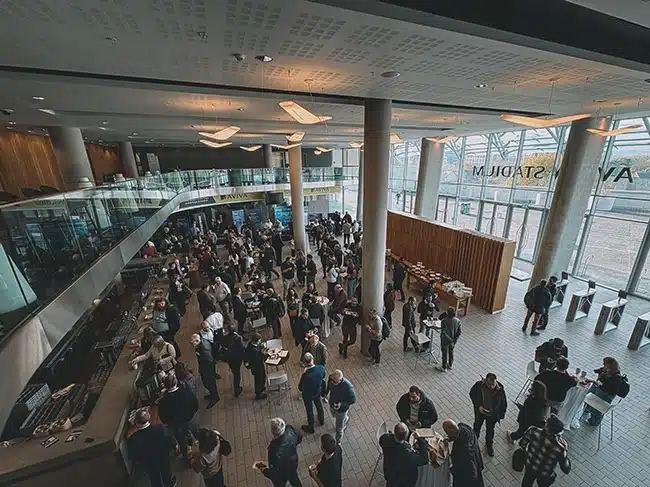
IRISSCON’s November timeslot is often a useful vantage point to recap the past 12 months in cybersecurity, but the 2026 edition focused on more immediate concerns. The conference coincided with the European Political Community summit in Dublin, and the gathering of EU and world leaders had sparked questions over Ireland’s cybersecurity and national security preparedness.
It’s why the conference kicked off with an unscheduled appeal by IRISSCERT founder Brian Honan who called on the Irish Government to escalate its efforts in dealing with hybrid attacks. Pointing to recent events including cyber attacks, espionage, sabotage, disinformation, and interference with critical infrastructure, he said: “We’re no longer dealing simply with criminals stealing money or hackers breaking into networks, but rather a dangerous new era of hybrid warfare.”
Despite assurances from political leaders that national security and cybersecurity are a top priority, Honan questioned whether the Irish Government is allocating sufficient resources and support to the Defence Forces, the Garda National Cyber Crime Bureau, and the National Cyber Security Centre (NCSC).
He praised the work of the NCSC which has operated since 2012 – and which launched its own updated National Cyber Security Strategy last month – but criticised the lack of a Government-led National Security plan that incorporates cybersecurity. “Statements unfortunately are not strategies and strategies without resources are just documents and words on paper,” he said.
Remote attacks, real world consequences
The days and weeks before IRISSCON saw remote attacks on supermarket refrigeration units, where it affected 13 SuperValu stores, and hoax bomb threats across several European countries, including in Ireland. On the morning of the conference, a fresh series of bomb threats were made against Irish schools, following a slew of similar alarms targeting media organisations the week before.
Detective Superintendent Michael Mullen of the Garda National Cyber Crime Bureau, who happened to be one of the scheduled speakers, reassured the audience the threats against schools weren’t credible. “Our information is, these are hoaxes,” he said.
The threat landscape has evolved drastically since Brian Honan and some colleagues working in cybersecurity set up a voluntary computer emergency response team, IRISSCERT, back in 2008, as the first CERT in Ireland to provide its services to the business community in Ireland for free. Honan said the Government’s continuing inaction on cybersecurity is evident in the two-year delay in transposing the EU’s NIS2 cybersecurity directive into national law.
A growing economic threat
Ireland’s cyber readiness goes beyond just national security and affects the Irish economy, Honan warned. Small and medium businesses in Ireland are “the backbone of Ireland’s economy” yet they have to protect themselves against cybersecurity risks with minimal guidance or support. “They cannot be expected to defend themselves against increasingly sophisticated threats without appropriate assistance in 2026,” he said. CSO figures show that 99.8 per cent of businesses in Ireland are classed as small firms, employing fewer than 250 people.
Cybersecurity professionals have responsibility to make their voices heard, Brian Honan added. “I’m asking each and every one of you that when you return to your organisations after today, you challenge your management teams and boards to make sure cybersecurity is treated as a business risk and not just simply another IT problem.”
Asking for action on cybersecurity
He also urged the audience to contact their political representatives and engage with industry bodies to ask for concrete actions, timelines and resources, to protect Ireland’s businesses, infrastructure, and its citizens. Flipping President John F Kennedy’s famous quote, Honan said: “We should ask not just what we can do for our country. We should also ask and expect clear answers as to what our government is doing to protect us from hybrid attacks.”
Hybrid attacks featured heavily in the keynote from guest speaker Dr Tarah Wheeler, a renowned security researcher and chief security officer at TPO Group, who using the example of attackers who targeted Danfoss commercial refrigeration and freezer units in supermarkets across France in October.
Fire alarm: a new kind of cybersecurity risk
Dr Wheeler noted how much of modern society relies on temperature control, such as heating, air conditioning, and food preservation. As more and more internet-connected temperature devices come into businesses and homes, manipulating them poses direct risks to human safety. The attackers who manipulated the systems and were able to raise the fridges’ temperature settings remotely to 50 degrees which caused physical damage and started fires.
This marks a worrying evolution from data theft or network intrusion into direct physical destruction. “I don’t know if I can emphasise to you how much that scares me. You can set places on fire with computers now; not in a movie, in reality. It has happened,” she said.
Say goodbye to security through obscurity
One of IRISSCON’s strengths is how it invites speakers who aren’t afraid to challenge conventional wisdom. Dr Wheeler argued that the traditional concept of security through obscurity has become obsolete when so many digital devices are connected to the internet yet poorly protected. “There are an extraordinary number of people who think they’re not important enough to be hacked,” she said. This was also the subject of an op-ed she wrote in the Financial Times.
Normally, the classic response to identifying vulnerabilities is to patch – and do it faster – but AI’s speed at discovering and exploiting flaws is threatening that long-held belief, according to Dick O’Brien, principal intelligence analyst with Symantec Carbon Black.
James Coker of InfoSecurity Magazine produced an excellent writeup based on this talk, noting that as discovery times shrink and exploits appear faster, organisations need to change to focusing on watching for suspicious behaviour rather than patching as a way to mitigate vulnerabilities. In a second article, James covered Bob McArdle’s presentation which anticipates an evolution and growth in ransomware over the coming year.
The AI factor in cybersecurity
Selena Larson, staff threat researcher on Proofpoint’s threat research team, got into IRISSCON’s myth-busting spirit, taking a very large pin to the growing hype bubble around AI’s ability to supposedly supercharge cybercriminal activity. She described the claim that AI is making threat actors smarter as “marketing nonsense”.
Proofpoint’s research has found that the vast majority of threat actors copy existing tooling or do the basics. “The best threat actors using AI were already the best threat actors,” Larson said. Symantec’s Dick O’Brien agreed with this argument in his own presentation, saying “the threat posed by frontier models really depends on whose hands they are in.”
Selena Larson pointed out that there’s a lot of poorly executed malware and vibe coded phishing lures. “AI is adding a lot of noise but not a lot of sophistication, based on the material I see… frankly, AI slop is taking over cybercrime.”
The day before IRISSCON kicked off, there was extensive media coverage, particularly around hybrid attacks. The Irish Independent covered Brian’s warning that Ireland was “dangerously unprepared”. Help Net Security’s conference preview led with a similar angle and it carried a follow-up story with photos from the conference. On the day, Brian spoke on Newstalk’s morning show, RTE’s Six One News and Virgin Media’s Tonight Show.
Some cybersecurity myths may have been busted over the course of 12 presentations from top-class Irish and international speakers, and there was plenty of practical advice from the stage that professionals could bring back to their organisations. But no-one leaving the Aviva Stadium after IRISSCON was left in any doubt over the scale of the challenge facing cybersecurity professionals and society at large.